Triumph Spitfire Mk4
The Spitfire of 1970–74, Michelotti's restyle for a new decade: a short tail like the Stag's, a cleaner nose and, underneath, the swing spring that tamed the swing axle. Triumph called it the Mk IV; it is also written Mark 4, Mk4 or MkIV.
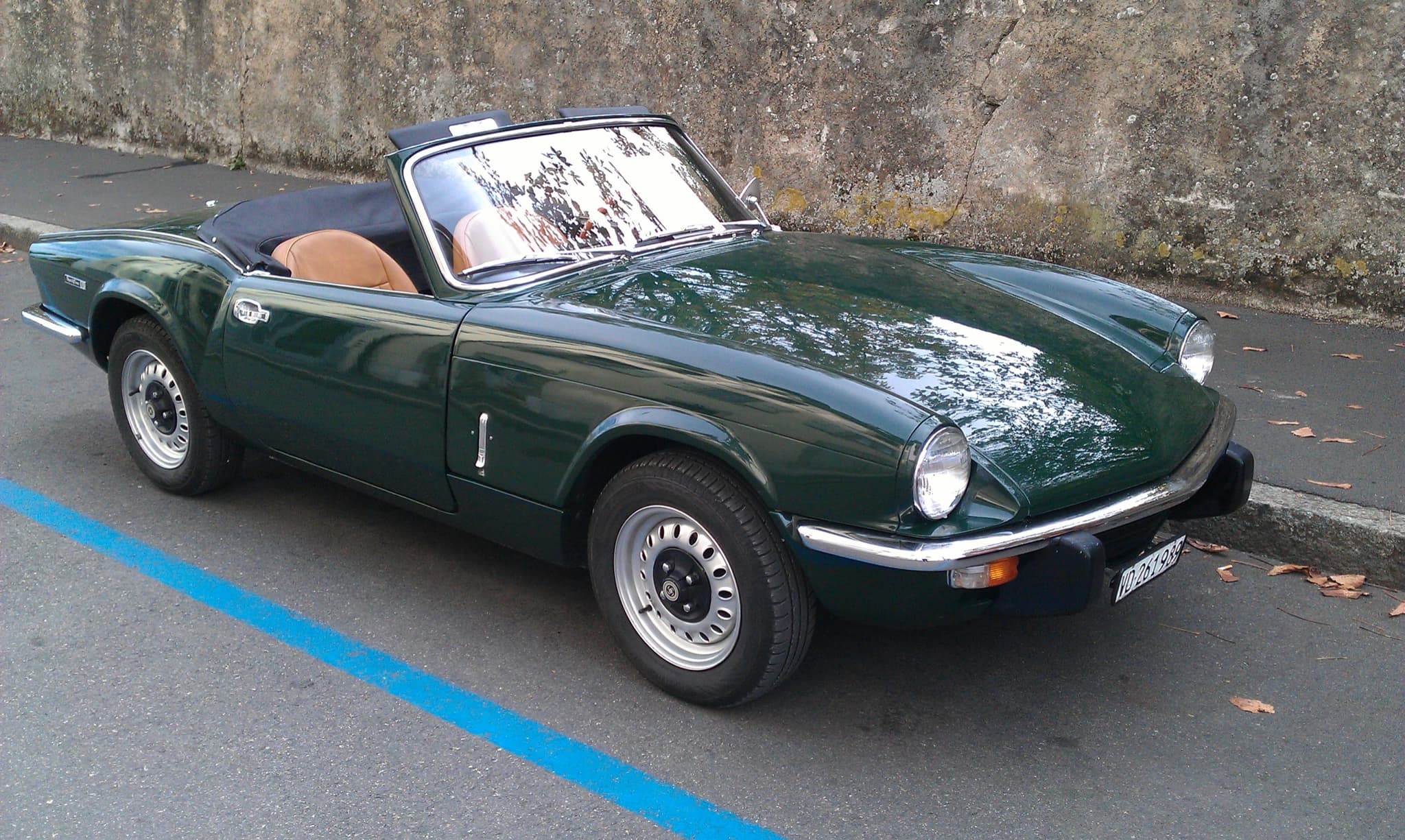
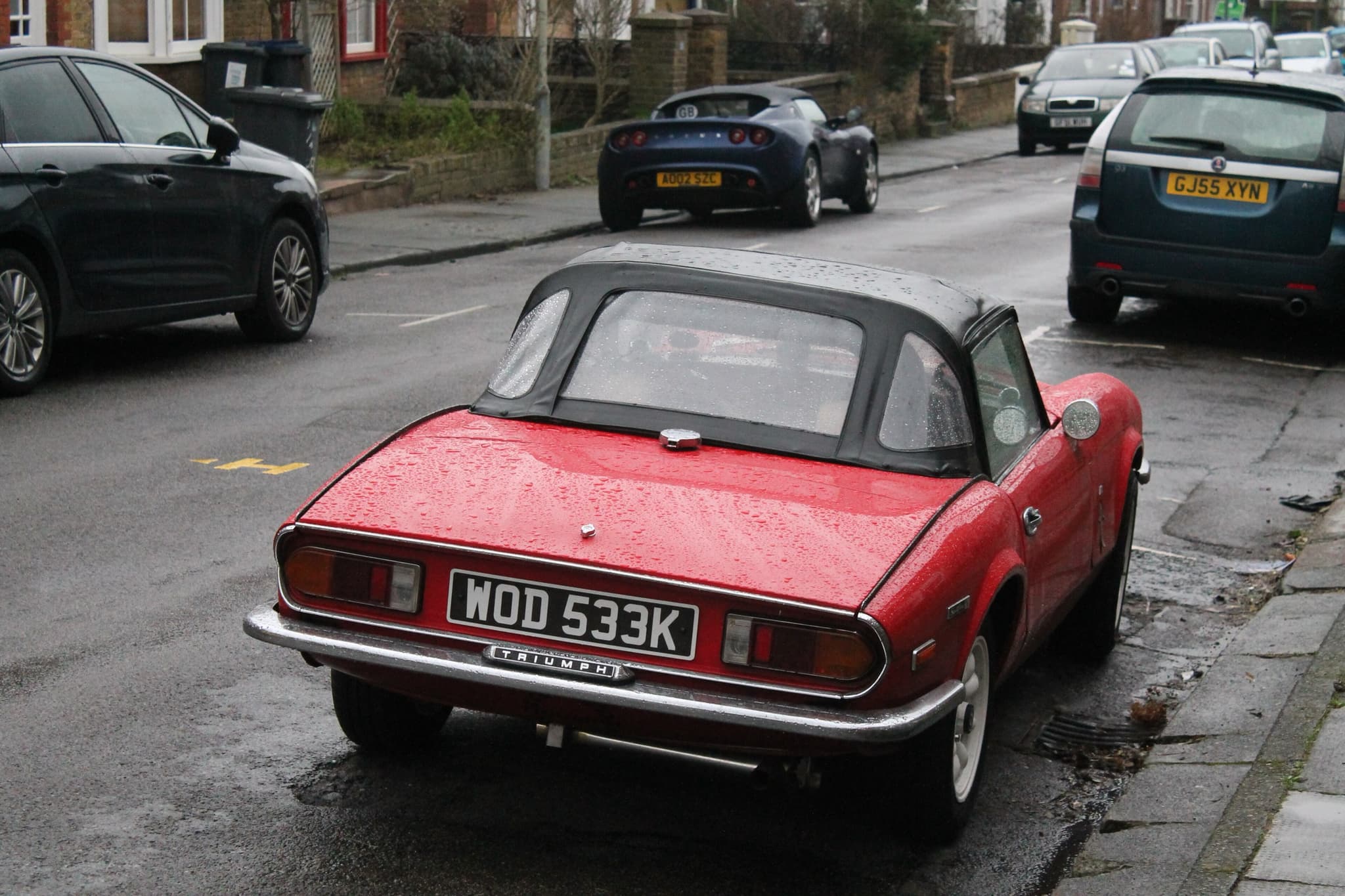
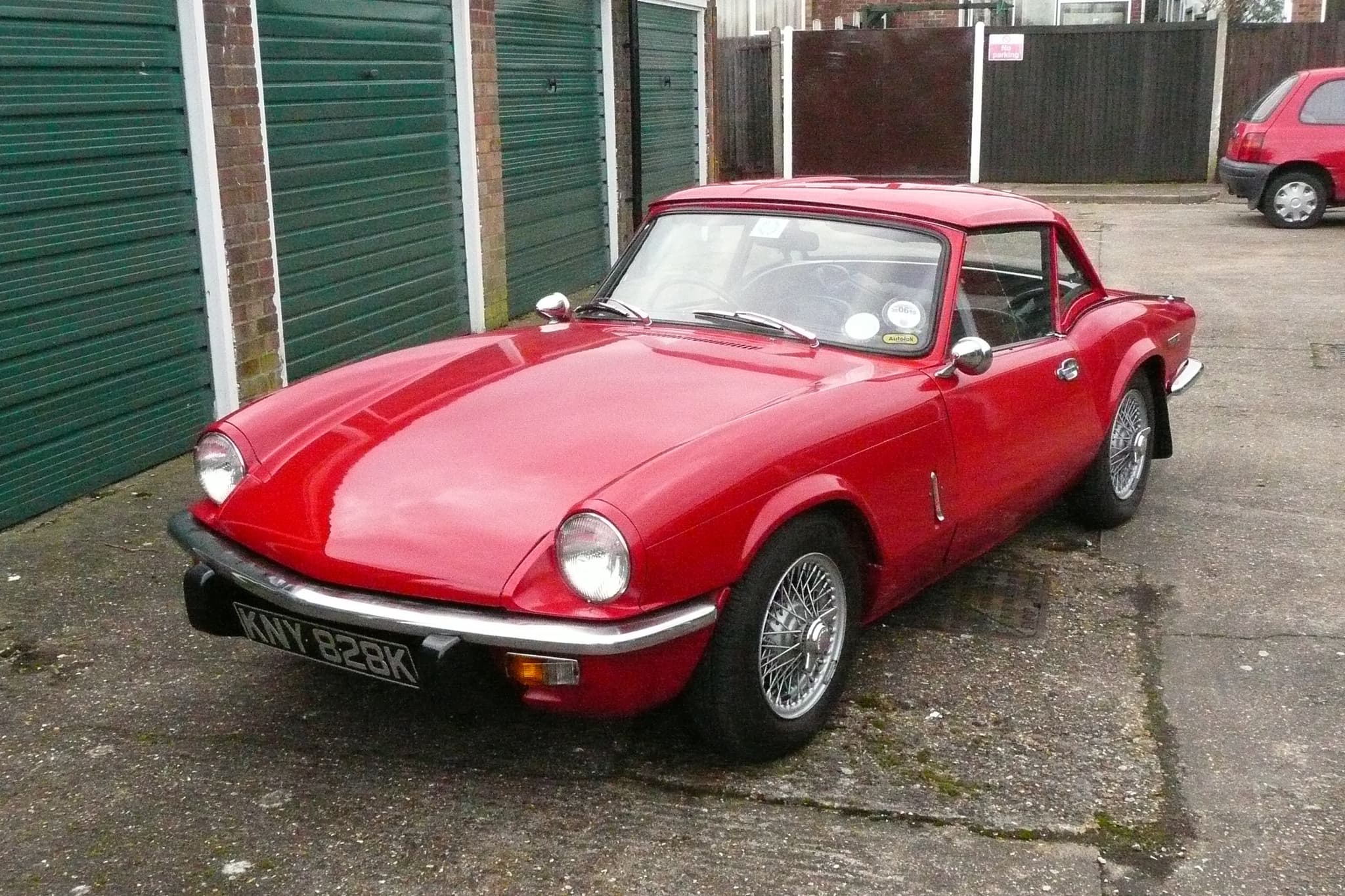
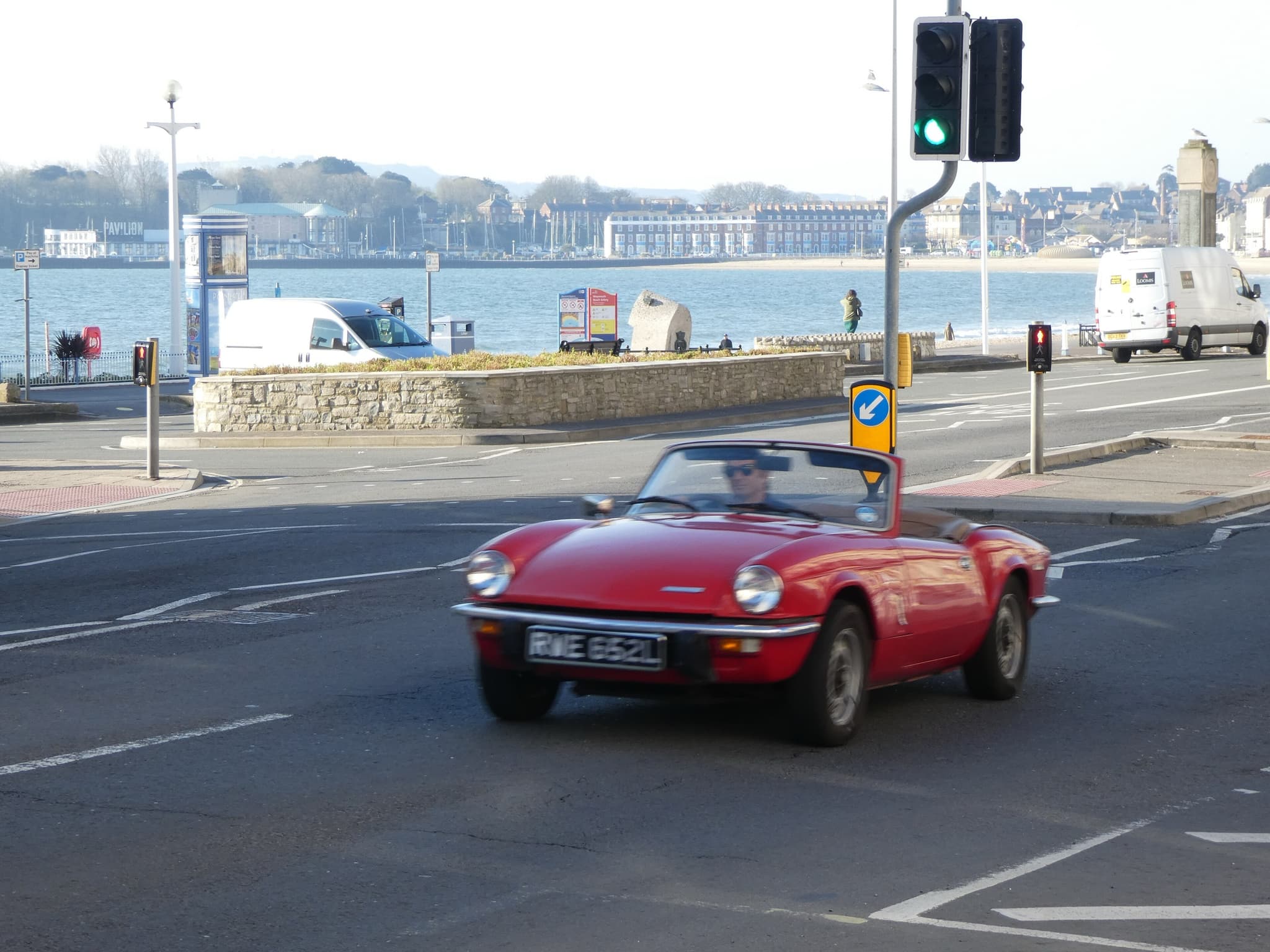
Walk round to the back of a Mk IV first. The tail is cut off short, in the manner of Triumph's Stag, and the bumper wraps round its corners. Giovanni Michelotti, who had styled the first Spitfire, reshaped it for the 1970s. The Mk IV was announced in October 1970 and built at Canley from November 1970 until late 1974 (December, in Canley Classics' table), when the Spitfire 1500 took its place in the same body.
Under the new skin, a "swing spring" tamed the swing axle's habit of tucking a rear wheel under and first gear gained synchromesh; inside, the dials moved to face the driver. On paper it had less power than the Mk III, which is the root of a myth: that Triumph detuned it.source 1source 2source 3source 4source 5source 6source 7
What changed
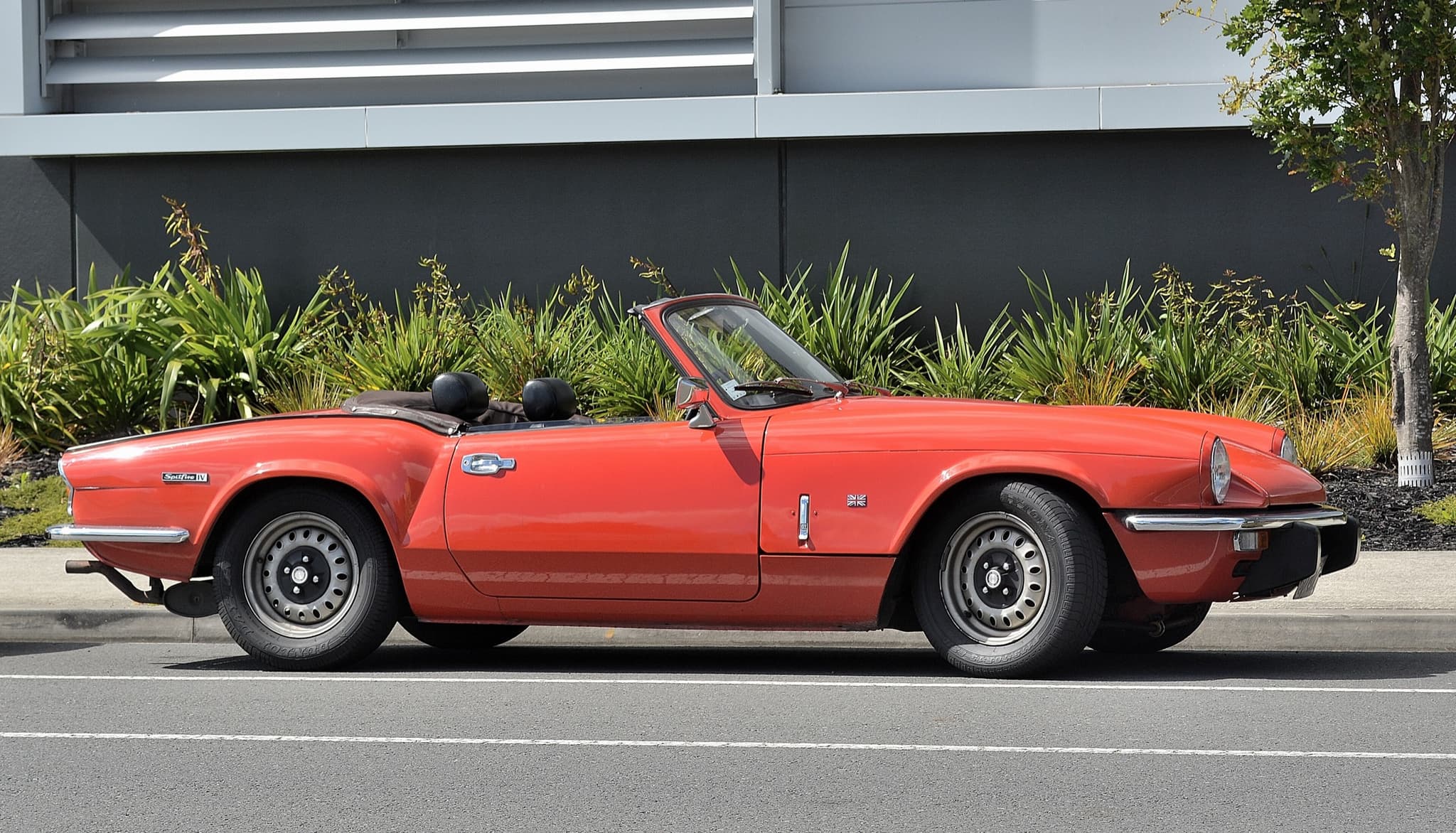
The Triumph Sports Six Club says the restyle took many of its cues from the Stag, then newly launched, and that only the sills (rocker panels) and the door skins survived from the Mk III. Bill Boddy, who tested a Mk IV for Motor Sport in January 1971, counted the rest: the new tail, a smoother bonnet (hood), wheel arches flared outwards and door handles recessed into the doors.
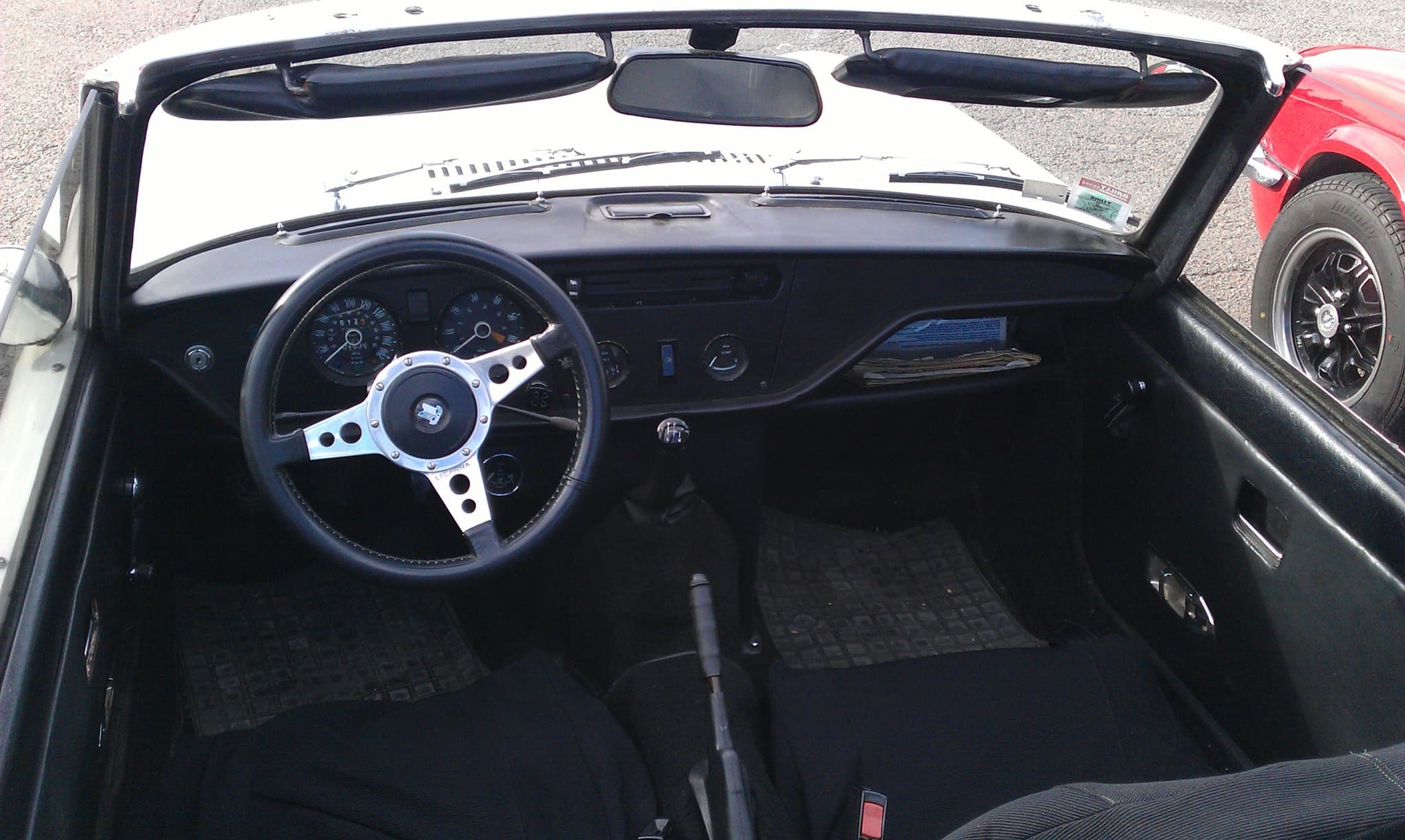
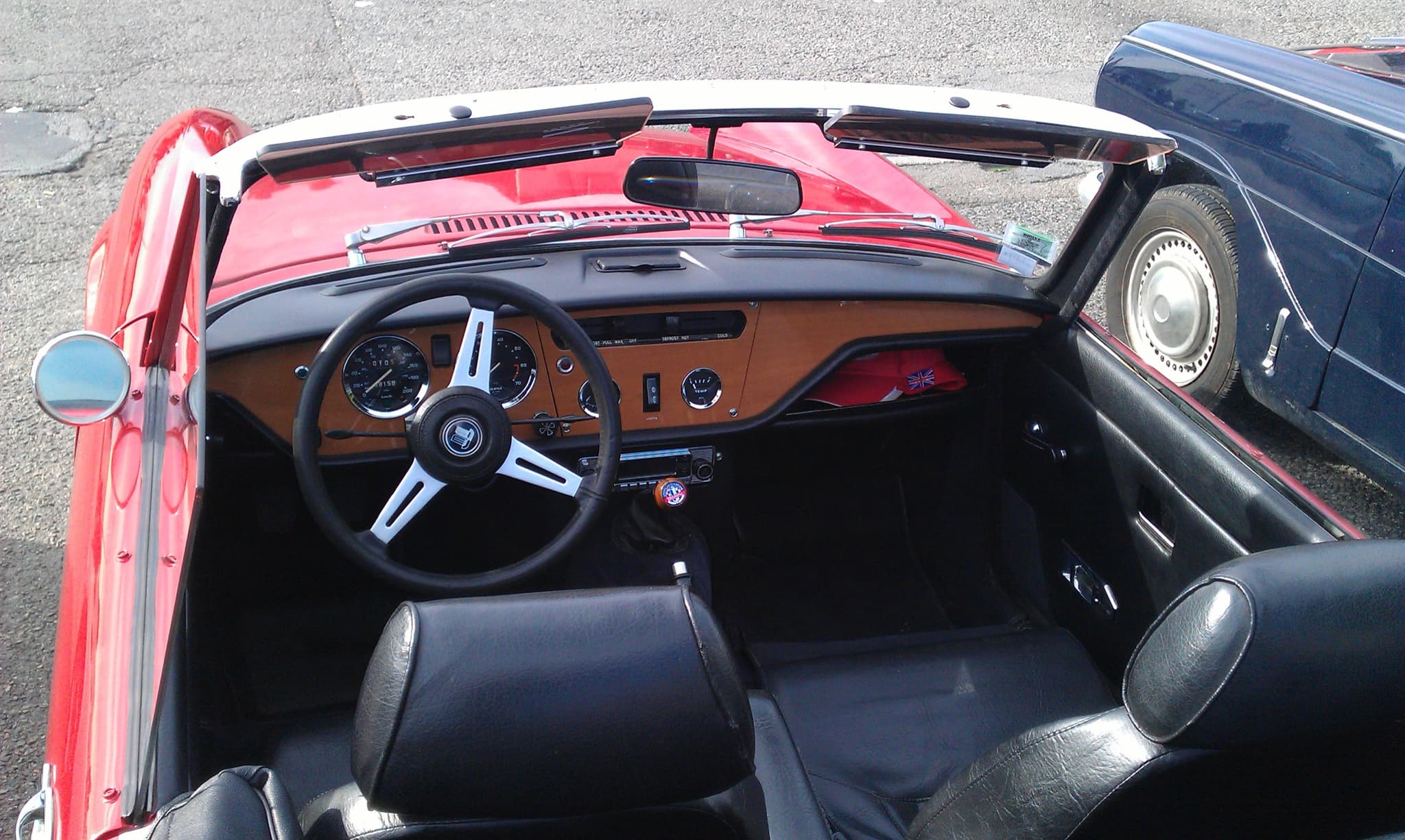
Inside, the speedometer and rev counter (tachometer) now faced the driver, set in a panel of matt black; from 1973, as the French brochure of that year shows, the panel was wood veneer, lit in green. Boddy's car had a steering lock on the ignition key, courtesy lights and two-speed wipers, and an alternator took the place of the dynamo (generator).
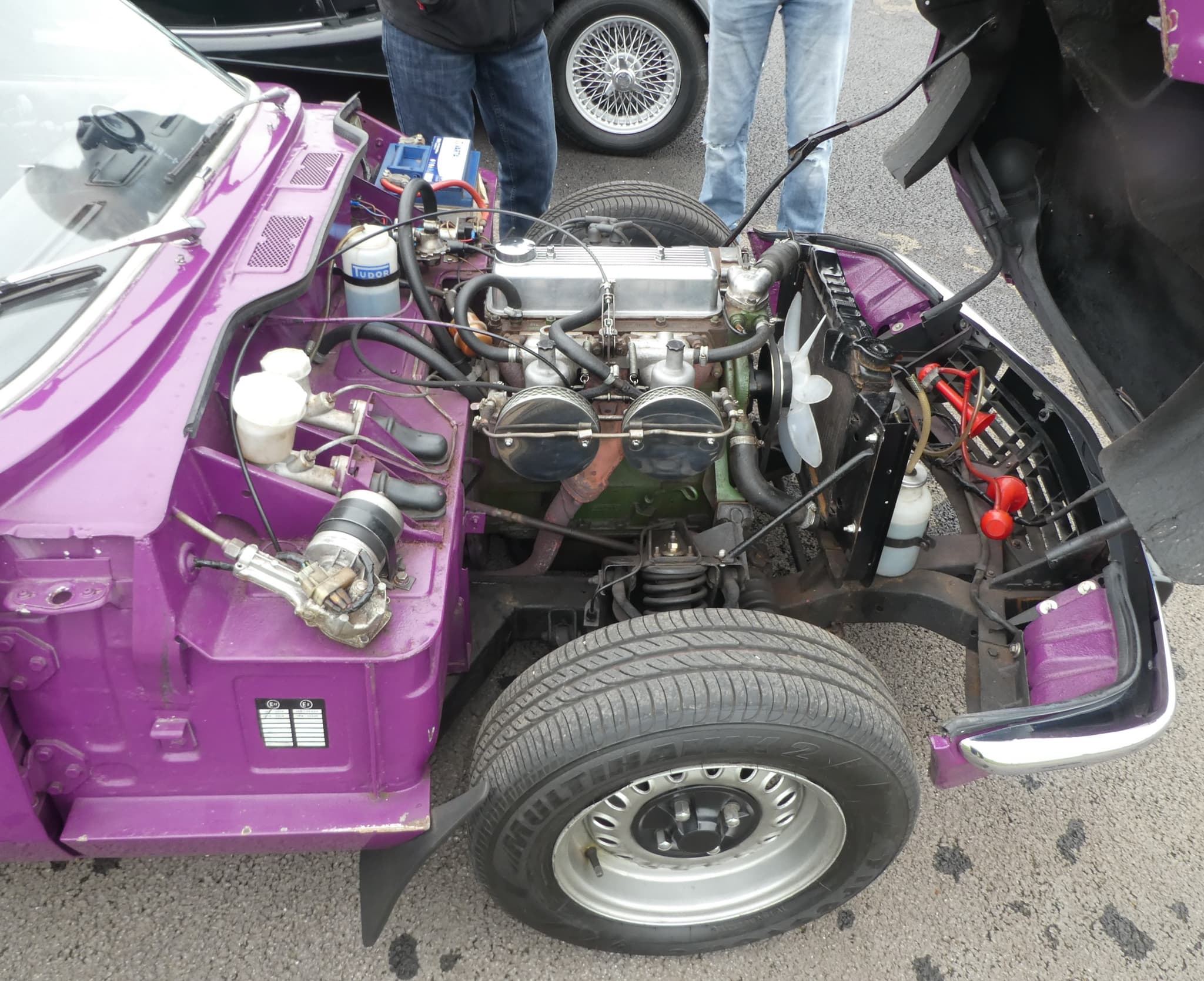
The engine was the Mk III's, with better manifolds. Behind it, the gearbox (transmission) at last had synchromesh on all four forward gears, and the final drive was taller.source 3source 4source 2source 8
The swing spring
The rear wheels still hung on swing axles, and on the earlier cars a hard corner could tuck one of them under. Triumph's answer kept the axles and changed the transverse leaf spring above them: only its bottom leaf was now clamped to the differential, the leaves above it were free to pivot on a central bolt, and the anti-roll (sway) bar at the front was made thicker. Canley Classics, which explains the arrangement, adds that it was no new idea:
The solution developed by Triumph in the 1960s (though interestingly not implemented until the 70s because it was deemed 'too expensive' by the bean-counters!) is known as the 'Swing Spring'.
It worked. A Motor Sport tester tried a Mk IV at Silverstone for the November 1970 issue, and Boddy passed on that tester's verdict: the handling could no longer be faulted. Hagerty's buying guide says the square-tailed cars put the problem right and are far friendlier to drive. How the spring works, and why the Mk IV did not take the Vitesse's rear suspension, are explained in the buying guide.source 7source 4source 9
Power, and the detuned myth
The charge that the Mk IV was detuned is an old one. Classic & Sports Car's A–Z regrets "a slightly de-tuned engine (disappointingly)", and Wikipedia says the engine was detuned to meet emission rules. The two cars' power figures, though, were not measured the same way. In 1967 Mike Cotton of Motor Sport suggested that the Mk III's was a gross figure, and in January 1971 Boddy gave the Mk IV's as a net one, from an engine that was otherwise the Mk III's. The Triumph Sports Six Club puts it plainly:
The engine is often said to have been de-tuned from Mk3 spec, but in fact only the system of measuring output changed – from SAE to DIN – so the drop from 75bhp to 63bhp was not a real one. The MkIV was slower though, thanks to both extra weight and the taller gearing used to improve economy.
The later cars are less clear. triumphspitfire.com dates a milder camshaft to about FH25000, in 1972, and, by our arithmetic on Clive Richardson's figures for the 1500 in Motor Sport in 1975, the last Mk IVs were rated a little lower than Boddy's car.
The specification below gives the Mk IV's figures with their ratings, and the Mk III's are on its own page.source 10source 11source 12source 4source 3source 13source 14source 2
How heavy is a Mk IV?
Fact check
779 kg
1,717 lb
Triumph Sports Six Club, Model pages: Spitfire 4/Mark II (model_ID=24), Mark III (23), Mark IV (25), 1500 (26), model_ID=25, "Weight"source 3
Practical Classics, "Buyers Guide: Triumph Spitfire", May 2000, p. 83 spec tablesource 15
Wikipedia (EN), "Triumph Spitfire", 2026, Mk IV sectionsource 11
734 kg
British Leyland (France), Triumph Spitfire Mk4 (sales brochure), France, 11/1973, T.919, Nov 1973 brochure, "Dimensions"source 8
Our reading. The Triumph Sports Six Club calls its figure a kerb weight and Practical Classics prints the same, while British Leyland's French brochure of 1973 gives the lighter one as its poids à vide, an empty weight. None says what was in the car when it was weighed, so the sources read cannot settle the difference, and both stand.source 3source 15source 8
How to spot a Mk IV
A Mk IV shares its body with the 1500, so check the details as well as the shape.
The tail
Cut off short, with a bumper that wraps round its corners.
The bonnet
Smooth along the tops of the wings (fenders): triumphspitfire.com's log says the raised edge and its finishing strip went with the Mk III.
The doors
Handles set into the door skins.
The wheels
Black centres on the steel wheels; the 1500's are silver.
The dashboard
Instruments in front of the driver, in a matt-black panel on the early cars and wood veneer from 1973.
The nose
A spoiler under the front bumper on the last Mk IVs, of 1974, as on the 1500.
No 1500 transfers
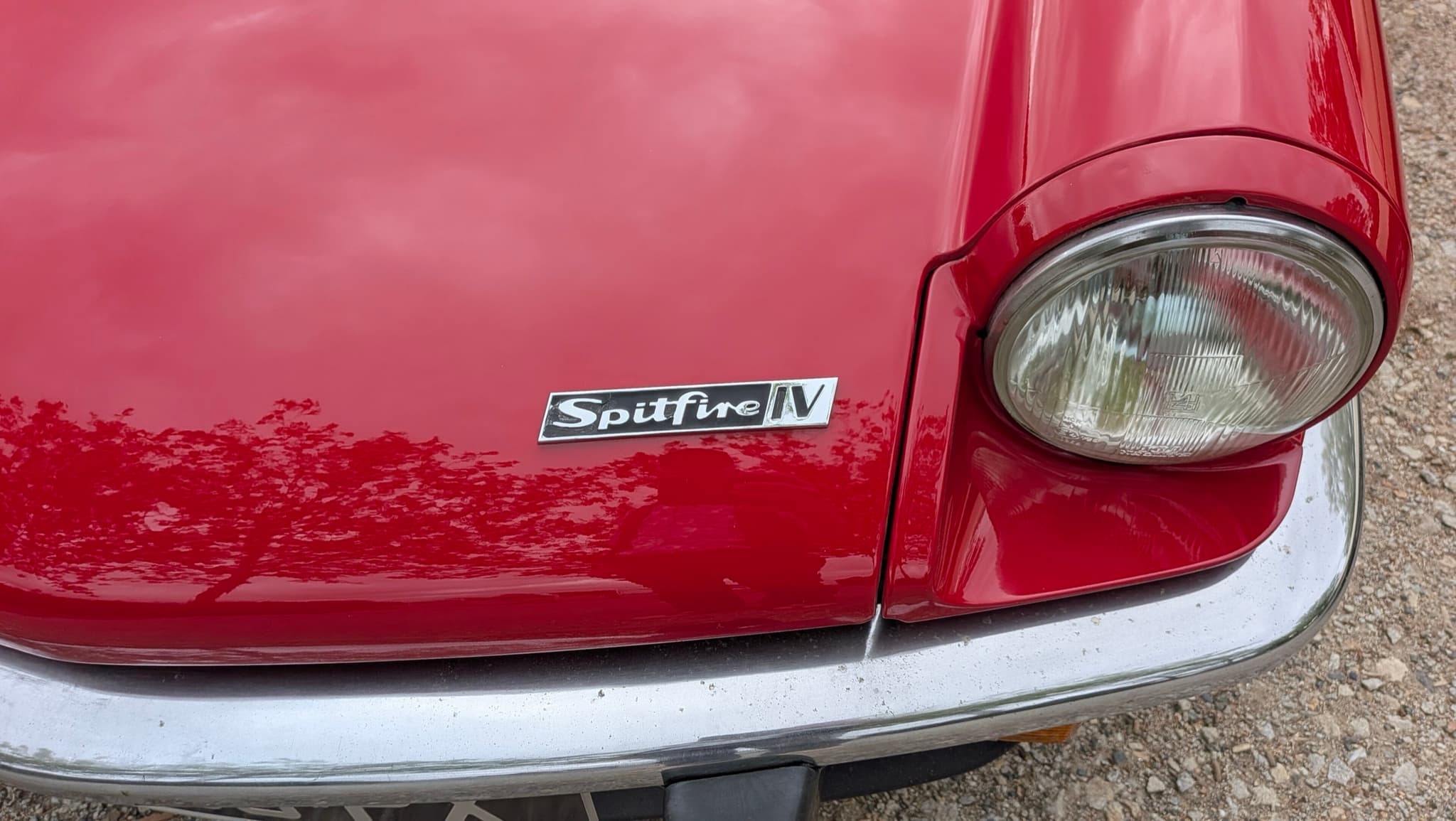
No "Spitfire 1500" on the bonnet or boot (trunk) lid.
The numbers
Outside North America a commission number from FH3 to FH64995, and an engine number beginning FH; identification reads both.source 4source 3source 8source 13source 16source 17source 18source 14source 6
Changes, 1970–74
Triumph kept changing the Mk IV through its life. Most of the change points come from triumphspitfire.com's logs, which give no sources, so the table names who records each one.source 14source 8source 13source 7source 16
| From | Change | Recorded by |
|---|---|---|
| About FH25000, 1972 | A milder camshaft | triumphspitfire.com |
| About FH28430 | A smaller fuel tank | triumphspitfire.com, though the tank in the November 1973 French brochure is still the bigger one |
| 1973 | The wood dashboard with green lighting | The French brochure of 1973; triumphspitfire.com dates it to February, from about FH50000 |
| 1973 | Longer drive shafts and rear spring, so a wider rear track | Motor Sport, March 1975 |
| 1973 | Reclining seats | triumphspitfire.com |
| 1974 | A spoiler under the front bumper | Motor Sport, March 1975 |
| January 1974 | A tonneau cover as standard in Britain | triumphspitfire.com; it is an option in the American brochure for the 1974 model year, probably a market difference |
| About FH60000 | A front chassis changed for impact rules, and the J-type overdrive | triumphspitfire.com; Canley Classics for the overdrive |
Production, price and options
The sources agree on how many Mk IVs were built: Canley Classics, Classic & Sports Car and the Triumph Sports Six Club are among the sources that print one figure, and the production table below gives it. None of them says whether it counts the American cars of the 1973 and 1974 model years, which had this body but were sold as Spitfire 1500s.
Boddy's test gave the price of the basic car in January 1971, purchase tax included, and the specification shows it beside the club's figure. His list of extras shows what a buyer could add: overdrive on third and top, switched from the gear-lever knob; a hardtop; wire wheels; radial or whitewall tyres; a tonneau cover; a radio; and a laminated windscreen (windshield). The hardtop and the other options are on hardtops and options.source 1source 3source 10source 4source 17
The American Mk IV
The Mk IV was also the American car of the 1971 and 1972 model years, and the Vintage Triumph Register's notes for those model years record the swing spring and the larger anti-roll bar. They were built with emission controls, and triumphspitfire.com gives them a single carburettor and a commission prefix of their own, FK. Classic & Sports Car gives them much less power than the British car, and Moss Motors and triumphspitfire.com give them different compression ratios; the American car's specification below shows the readings.
From the 1973 model year American cars kept this body but were given the 1500's longer-stroke engine ahead of everyone else, and the name Spitfire 1500 with it; cars for every other market waited for that engine until late 1974. North American Spitfires tells the American cars' story model year by model year.source 17source 14source 2source 19source 16source 1
On the road
Boddy's test car was red, with overdrive, a radio and radial tyres, and he "genuinely liked" it. He found the imitation-leather trim and moulded carpets good, the steering taut and smooth, and the grip on Dunlop's radials sure even in the wet. On bad surfaces the car shook and juddered a little. The engine ran smoothly above 2,000 rpm but grew busy near the top of third gear, the gear change was notchy, reverse was engaged by pressing the knob down, which he found a little unusual, and the brakes worked well if pushed firmly; as in 1963, there was no oil-pressure gauge. On performance he passed on a claim:
Weight is up by 54 lb. but performance is claimed not to have deteriorated, as improved manifolding has moderately uprated the power output.
What the other period testers found, and how they timed it, is on road tests.
Michelotti's body outlived the car it was drawn for. The 1500 kept it from late 1974 (from the 1973 model year in America), and the last Spitfire of all was built in it in August 1980.source 4source 20source 1source 21
Specification: Mk IV
Production
Sources for Production, Mk IV
- Price new
- Several figures in print.Bill Boddy ("W.B."), "Road test: The Triumph Spitfire Mk. IV", Motor Sport, Jan 1971source 4; Triumph Sports Six Club, Model pages: Spitfire 4/Mark II (model_ID=24), Mark III (23), Mark IV (25), 1500 (26)source 3; triumphspitfire.com ("Spitfire & GT6 Magazine and Information Warehouse"), Reference pages (group): models and options; Mk I–1500 options-and-changes logs; engine numbers; 1979–80 VINs; what year is my car; final drive; general specification data; stock tyres; wheel alignment; lubrication; tuning; fuses; paint and trim codes; side stripes; decal and badge placements; wire wheels; head swaps; substitute parts; suppliers; new owner; pre-purchase checklist; spotters guide, pages modified 2023source 14
| Price new | £961 17s 6d Price new, Mk IV Several figures in print.
|
|---|
Engine
Sources for Engine, Mk IV
- Capacity
- Good sources agree.Bill Boddy ("W.B."), "Road test: The Triumph Spitfire Mk. IV", Motor Sport, Jan 1971source 4; Canley Classics, "Engine Number Identification Chart"source 18; Triumph Spitfire Club (Netherlands), "Spitfire modellen", "Aankoop informatie", "Clubinfo", homesource 22
- Bore × stroke
- Good sources agree.Three main bearings. Bill Boddy ("W.B."), "Road test: The Triumph Spitfire Mk. IV", Motor Sport, Jan 1971source 4; British Leyland (France), Triumph Spitfire Mk4 (sales brochure), France, 11/1973, T.919source 8
- Compression ratio
- Good sources agree.97-octane fuel. Bill Boddy ("W.B."), "Road test: The Triumph Spitfire Mk. IV", Motor Sport, Jan 1971source 4; British Leyland (France), Triumph Spitfire Mk4 (sales brochure), France, 11/1973, T.919source 8; triumphspitfire.com ("Spitfire & GT6 Magazine and Information Warehouse"), Reference pages (group): models and options; Mk I–1500 options-and-changes logs; engine numbers; 1979–80 VINs; what year is my car; final drive; general specification data; stock tyres; wheel alignment; lubrication; tuning; fuses; paint and trim codes; side stripes; decal and badge placements; wire wheels; head swaps; substitute parts; suppliers; new owner; pre-purchase checklist; spotters guide, pages modified 2023source 14
- Carburettors
- One good source.Non-US. Bill Boddy ("W.B."), "Road test: The Triumph Spitfire Mk. IV", Motor Sport, Jan 1971source 4
| Capacity | 1,296 cc |
|---|---|
| Bore × stroke | 73.7 × 76 mm |
| Compression ratio | 9:1 |
| Carburettors | twin SU HS2 |
Performance
Sources for Performance, Mk IV
- Power
- Several figures in print.Bill Boddy ("W.B."), "Road test: The Triumph Spitfire Mk. IV", Motor Sport, Jan 1971source 4; Triumph Sports Six Club, Model pages: Spitfire 4/Mark II (model_ID=24), Mark III (23), Mark IV (25), 1500 (26)source 3; British Leyland (France), Triumph Spitfire Mk4 (sales brochure), France, 11/1973, T.919source 8; Practical Classics, "Buyers Guide: Triumph Spitfire", May 2000source 15; Wikipedia (DE), "Triumph Spitfire", 2026source 23; Clive Richardson ("C.R."), "Road Impressions – The Triumph Spitfire 1500", Motor Sport, Mar 1975source 13
- Torque
- Several figures in print.Bill Boddy ("W.B."), "Road test: The Triumph Spitfire Mk. IV", Motor Sport, Jan 1971source 4; Triumph Sports Six Club, Model pages: Spitfire 4/Mark II (model_ID=24), Mark III (23), Mark IV (25), 1500 (26)source 3; Practical Classics, "Buyers Guide: Triumph Spitfire", May 2000source 15; Clive Richardson ("C.R."), "Road Impressions – The Triumph Spitfire 1500", Motor Sport, Mar 1975source 13
- Top speed
- Several figures in print.British Leyland (France), Triumph Spitfire Mk4 (sales brochure), France, 11/1973, T.919source 8; Bill Boddy ("W.B."), "Road test: The Triumph Spitfire Mk. IV", Motor Sport, Jan 1971source 4; Clive Richardson ("C.R."), "Road Impressions – The Triumph Spitfire 1500", Motor Sport, Mar 1975source 13; Triumph Sports Six Club, Model pages: Spitfire 4/Mark II (model_ID=24), Mark III (23), Mark IV (25), 1500 (26)source 3; triumphspitfire.com, "Top Speed and Track Test Results", 2023source 24
- 0–60 mph
- Several figures in print.Triumph Sports Six Club, Model pages: Spitfire 4/Mark II (model_ID=24), Mark III (23), Mark IV (25), 1500 (26)source 3; Practical Classics, "Buyers Guide: Triumph Spitfire", May 2000source 15; Bill Boddy ("W.B."), "Road test: The Triumph Spitfire Mk. IV", Motor Sport, Jan 1971source 4; Clive Richardson ("C.R."), "Road Impressions – The Triumph Spitfire 1500", Motor Sport, Mar 1975source 13; triumphspitfire.com, "Top Speed and Track Test Results", 2023source 24; Wikipedia (EN), "Triumph Spitfire", 2026source 11
| Power | 63 bhp Power, Mk IV Several figures in print.
|
|---|---|
| Torque | 837 lb in Torque, Mk IV Several figures in print.
|
| Top speed | 156 km/h Top speed, Mk IV Several figures in print.
|
| 0–60 mph | 16.2 s 0–60 mph, Mk IV Several figures in print.
|
Running gear
Sources for Running gear, Mk IV
- Steering
- One good source.Bill Boddy ("W.B."), "Road test: The Triumph Spitfire Mk. IV", Motor Sport, Jan 1971source 4
- Overdrive
- One good source.Bill Boddy ("W.B."), "Road test: The Triumph Spitfire Mk. IV", Motor Sport, Jan 1971source 4
- Front brakes
- Several figures in print.British Leyland (France), Triumph Spitfire Mk4 (sales brochure), France, 11/1973, T.919source 8; Triumph Sportscars (Australia; closed end of 2016), "Spitty Tips" 2, 3, 4, 5, 6, 8, 19source 25
- Rear brakes
- Several figures in print.British Leyland (France), Triumph Spitfire Mk4 (sales brochure), France, 11/1973, T.919source 8; Triumph Sportscars (Australia; closed end of 2016), "Spitty Tips" 2, 3, 4, 5, 6, 8, 19source 25
- Tyres
- Several figures in print.Bill Boddy ("W.B."), "Road test: The Triumph Spitfire Mk. IV", Motor Sport, Jan 1971source 4; triumphspitfire.com ("Spitfire & GT6 Magazine and Information Warehouse"), Reference pages (group): models and options; Mk I–1500 options-and-changes logs; engine numbers; 1979–80 VINs; what year is my car; final drive; general specification data; stock tyres; wheel alignment; lubrication; tuning; fuses; paint and trim codes; side stripes; decal and badge placements; wire wheels; head swaps; substitute parts; suppliers; new owner; pre-purchase checklist; spotters guide, pages modified 2023source 14; British Leyland (France), Triumph Spitfire Mk4 (sales brochure), France, 11/1973, T.919source 8
- Wheels
- Several figures in print.British Leyland (France), Triumph Spitfire Mk4 (sales brochure), France, 11/1973, T.919source 8; Triumph Sportscars (Australia; closed end of 2016), "Spitty Tips" 2, 3, 4, 5, 6, 8, 19source 25; triumphspitfire.com ("Spitfire & GT6 Magazine and Information Warehouse"), Reference pages (group): models and options; Mk I–1500 options-and-changes logs; engine numbers; 1979–80 VINs; what year is my car; final drive; general specification data; stock tyres; wheel alignment; lubrication; tuning; fuses; paint and trim codes; side stripes; decal and badge placements; wire wheels; head swaps; substitute parts; suppliers; new owner; pre-purchase checklist; spotters guide, pages modified 2023source 14; Practical Classics, "Buyers Guide: Triumph Spitfire", May 2000source 15
| Steering | 3.7 turns lock to lock, 15 in three-spoke wheel |
|---|---|
| Overdrive | on 3rd (4.34:1 overall) and top (3.12:1 overall), D-type, optional |
| Front brakes | 228 mm (9 in) discs Front brakes, Mk IV Several figures in print. |
| Rear brakes | 7 × 1¼ in (178 × 32 mm) drums Rear brakes, Mk IV Several figures in print. |
| Tyres | 5.20-13 cross-ply standard; Dunlop SP68 radials optional Tyres, Mk IV Several figures in print.
|
| Wheels | 13 × 4½ J Wheels, Mk IV Several figures in print.
|
Dimensions and weight
Sources for Dimensions and weight, Mk IV
- Length
- Good sources agree.Triumph Sports Six Club, Model pages: Spitfire 4/Mark II (model_ID=24), Mark III (23), Mark IV (25), 1500 (26)source 3; British Leyland (France), Triumph Spitfire Mk4 (sales brochure), France, 11/1973, T.919source 8
- Width
- Good sources agree.58.5 in. British Leyland (France), Triumph Spitfire Mk4 (sales brochure), France, 11/1973, T.919source 8; Triumph Sports Six Club, Model pages: Spitfire 4/Mark II (model_ID=24), Mark III (23), Mark IV (25), 1500 (26)source 3
- Height
- Several figures in print.British Leyland (France), Triumph Spitfire Mk4 (sales brochure), France, 11/1973, T.919source 8; Triumph Sports Six Club, Model pages: Spitfire 4/Mark II (model_ID=24), Mark III (23), Mark IV (25), 1500 (26)source 3
- Kerb weight
- Good sources disagree.Triumph Sports Six Club, Model pages: Spitfire 4/Mark II (model_ID=24), Mark III (23), Mark IV (25), 1500 (26)source 3; Practical Classics, "Buyers Guide: Triumph Spitfire", May 2000source 15; British Leyland (France), Triumph Spitfire Mk4 (sales brochure), France, 11/1973, T.919source 8; Wikipedia (EN), "Triumph Spitfire", 2026source 11
- Wheelbase
- Good sources agree.83 in. British Leyland (France), Triumph Spitfire Mk4 (sales brochure), France, 11/1973, T.919source 8; Triumph Sports Six Club, Model pages: Spitfire 4/Mark II (model_ID=24), Mark III (23), Mark IV (25), 1500 (26)source 3
- Ground clearance
- Good sources agree.Laden; 5 in. British Leyland (France), Triumph Spitfire Mk4 (sales brochure), France, 11/1973, T.919source 8; Bill Boddy ("W.B."), "Road test: The Triumph Spitfire Mk. IV", Motor Sport, Jan 1971source 4
- Fuel tank
- Several figures in print.British Leyland (France), Triumph Spitfire Mk4 (sales brochure), France, 11/1973, T.919source 8; Bill Boddy ("W.B."), "Road test: The Triumph Spitfire Mk. IV", Motor Sport, Jan 1971source 4; triumphspitfire.com ("Spitfire & GT6 Magazine and Information Warehouse"), Reference pages (group): models and options; Mk I–1500 options-and-changes logs; engine numbers; 1979–80 VINs; what year is my car; final drive; general specification data; stock tyres; wheel alignment; lubrication; tuning; fuses; paint and trim codes; side stripes; decal and badge placements; wire wheels; head swaps; substitute parts; suppliers; new owner; pre-purchase checklist; spotters guide, pages modified 2023source 14
| Length | 3,786 mm |
|---|---|
| Width | 1,488 mm |
| Height | 1,205 mm Height, Mk IV Several figures in print.
|
| Kerb weight | 779 kg Kerb weight, Mk IV Good sources disagree.
|
| Wheelbase | 2,110 mm |
| Ground clearance | 127 mm |
| Fuel tank | 37.6 L Fuel tank, Mk IV Several figures in print.
|
Specification: US
Engine
Sources for Engine, US
- Compression ratio
- Several figures in print.Moss Motors, "Car Specifications – Triumph Spitfire Mk IV 1971–1974"; "…Spitfire 1500 (1975–1980)"source 19; triumphspitfire.com ("Spitfire & GT6 Magazine and Information Warehouse"), Reference pages (group): models and options; Mk I–1500 options-and-changes logs; engine numbers; 1979–80 VINs; what year is my car; final drive; general specification data; stock tyres; wheel alignment; lubrication; tuning; fuses; paint and trim codes; side stripes; decal and badge placements; wire wheels; head swaps; substitute parts; suppliers; new owner; pre-purchase checklist; spotters guide, pages modified 2023source 14
| Compression ratio | 8.5:1 Compression ratio, US Several figures in print.
|
|---|
Performance
Sources for Performance, US
- Power
- Several figures in print.Malcolm McKay, "Triumph Spitfire buyer's guide: what to pay and what to look for", Classic & Sports Car, 10 May 2019source 2; Hagerty (US), Valuation and model overview pages (US)source 26
- Top speed
- Not yet confirmed.US 1971. triumphspitfire.com, "Top Speed and Track Test Results", 2023source 24
- 0–60 mph
- Not yet confirmed.Road & Track, May 1971 (US car). triumphspitfire.com, "Top Speed and Track Test Results", 2023source 24
| Power | 48 bhp Power, US Several figures in print. |
|---|---|
| Top speed | 86 mph |
| 0–60 mph | 15.9 s |
Dimensions and weight
Sources for Dimensions and weight, US
- Length
- One good source.US Mk IV 1971–74 (one figure for the whole span, so not written to the 1971–72 node's specs). Moss Motors, "Car Specifications – Triumph Spitfire Mk IV 1971–1974"; "…Spitfire 1500 (1975–1980)"source 19
- Kerb weight
- One good source.Kerb, US Mk IV and 1500 (unladen 1,638–1,761 lb). Moss Motors, "Car Specifications – Triumph Spitfire Mk IV 1971–1974"; "…Spitfire 1500 (1975–1980)"source 19
| Length | 155.25 in |
|---|---|
| Kerb weight | 1,750–1,850 lb |
Production
Production: how far the sources agree
- 70,021, Mk IV, Nov 1970–Dec 1974; whether the US 1973–74 FM cars are included is not stated
- Good sources agree.
70,021Mk IV, Nov 1970–Dec 1974; whether the US 1973–74 FM cars are included is not stated
Canley Classics, "Production Figures"source 1; Triumph Sports Six Club, Model pages: Spitfire 4/Mark II (model_ID=24), Mark III (23), Mark IV (25), 1500 (26)source 3; Classic & Sports Car, A–Z of classics: Triumph Spitfire I, II, III, MkIV, 1500source 10; Wikipedia (EN), "Triumph Spitfire", 2026source 11; Triumph Spitfire Club (Netherlands), "Spitfire modellen", "Aankoop informatie", "Clubinfo", homesource 22; triumphspitfire.com ("Spitfire & GT6 Magazine and Information Warehouse"), Reference pages (group): models and options; Mk I–1500 options-and-changes logs; engine numbers; 1979–80 VINs; what year is my car; final drive; general specification data; stock tyres; wheel alignment; lubrication; tuning; fuses; paint and trim codes; side stripes; decal and badge placements; wire wheels; head swaps; substitute parts; suppliers; new owner; pre-purchase checklist; spotters guide, pages modified 2023source 14
Sources
Sources are given as plain text; their addresses are on the sources page.
- Primarymade at the time, by the maker or by people who were there
- Referenceserious later work: clubs, specialists, magazines, books
- Uncheckedencyclopaedias and enthusiast sites: cited beside a good source, named in the sentence, or marked Unchecked
- Canley Classics, "Production Figures", Spitfire MK IV, November 1970–December 1974; Spitfire MK IV row; Spitfire 1500 row; Spitfire 1500, December 1974–August 1980; Production Figures table, row "Spitfire MK IV". Reference
- Malcolm McKay, "Triumph Spitfire buyer's guide: what to pay and what to look for", Classic & Sports Car, 10 May 2019, timeline, October 1970; US section. Reference
- Triumph Sports Six Club, Model pages: Spitfire 4/Mark II (model_ID=24), Mark III (23), Mark IV (25), 1500 (26), Mark IV page; model_ID=25, "Weight"; Mark IV page, "Weight"; Mark IV and 1500 pages, wheel centres; Mark IV page, quantity and cost when new; model_ID=25 (Mark IV page), "Cost when new"; model_ID=25 (Mark IV page) ("SAE to DIN"); model_ID=25 (Mark IV page); model_ID=25, "Dimensions"; model_ID=25, "Quantity". Reference
- Bill Boddy ("W.B."), "Road test: The Triumph Spitfire Mk. IV", Motor Sport, Jan 1971, p. 59; p. 59: body, facia, gearbox, axle ratio, equipment; p. 59: anti-roll bar; the Silverstone impressions of November 1970; p. 59, the engine; p. 59: body, wheels, facia; p. 59, final paragraph: price and extras; Jan 1971 p. 59, final paragraph; Jan 1971 p. 59, engine paragraph; Jan 1971 p. 59, consumption paragraph; Jan 1971 p. 59, controls paragraph; Jan 1971 p. 59, engine paragraph ("63 (net) b.h.p."); Jan 1971 p. 59. Primary
- Graham Robson, "Harry Webster – My Technical Mentor", Moss Motoring (Moss Motors), 12 Jun 2019, Michelotti and the prototype. Reference
- BL Cars / Jaguar Rover Triumph Ltd, Triumph Spitfire 1500 (sales brochure), UK, 12/1978, Publication No. 3254/D, description of the body: wrap-round bumpers. Primary
- John Kipping (overdrive articles), Technical articles (group): "Swing Springs", "Rear End Noises", "Propshaft Problems", "Oil Consumption", "Unleaded Engines", "The D-Type Overdrive", "The J-Type Overdrive", "Different Differentials", "Close Ratio Gearboxes For Spitfire MkIV/1500", "Chrome Bumpers", "Spitfire Tuning Kits", "Fitting Le Mans Style Bonnet Vents", Canley Classics, "Swing Springs"; "The J-Type Overdrive". Reference
- British Leyland (France), Triumph Spitfire Mk4 (sales brochure), France, 11/1973, T.919, description: the wood dashboard; Nov 1973 brochure, "Dimensions"; "Dimensions", poids à vide; description: dashboard and rear track; "Capacités"; Nov 1973 brochure, "Moteur"; Nov 1973 brochure, "Performances"; Nov 1973 brochure, "Freins"; Nov 1973 brochure, "Pneus"; Nov 1973 brochure, "Roues"; Nov 1973 brochure, diagram "B"; Nov 1973 brochure, diagram; Nov 1973 brochure, diagram "A"; Nov 1973 brochure, "Empattement"; Nov 1973 brochure, "Capacités". Primary
- Sam Skelton, "Buying Guide: Triumph Spitfire (1962–1980)", Hagerty UK, 3 Feb 2021, handling. Reference
- Classic & Sports Car, A–Z of classics: Triumph Spitfire I, II, III, MkIV, 1500, Triumph Spitfire MkIV; A–Z entry. Reference
- Wikipedia (EN), "Triumph Spitfire", 2026, Mk IV section; production figures, citing Robson 1982 p. 187. Unchecked
- Mike Cotton ("M.L.C."), "Triumph Spitfire to Monaco", Motor Sport, Jun 1967, p. 26, the engine. Primary
- Clive Richardson ("C.R."), "Road Impressions – The Triumph Spitfire 1500", Motor Sport, Mar 1975, p. 25, the power output; p. 25: transfers and the front spoiler; p. 25: the rear track and the front spoiler; Mar 1975 p. 25, text; Mar 1975 p. 25, para 4. Primary
- triumphspitfire.com ("Spitfire & GT6 Magazine and Information Warehouse"), Reference pages (group): models and options; Mk I–1500 options-and-changes logs; engine numbers; 1979–80 VINs; what year is my car; final drive; general specification data; stock tyres; wheel alignment; lubrication; tuning; fuses; paint and trim codes; side stripes; decal and badge placements; wire wheels; head swaps; substitute parts; suppliers; new owner; pre-purchase checklist; spotters guide, pages modified 2023, Mk IV options-and-changes log, FH25000; Mk IV options-and-changes log, body; Mk IV options-and-changes log; models page; engine numbers; Mk IV page, basic price; engine page; stock tyre page; Mk IV change log; Mk IV table; models page. Unchecked
- Practical Classics, "Buyers Guide: Triumph Spitfire", May 2000, p. 83 spec table; p. 83, specification table. Reference
- British Leyland Motors Inc., Spitfire 1500 (sales brochure), USA, 1974 model year, SP741, 1973, "New for 1974", the spoiler; options: tonneau cover; cover. Primary
- Vintage Triumph Register, "Spitfire" (production history, production dates and numbers, buyer's guide tabs), production dates and numbers: FH3–FH64995; production dates and numbers: 1973–1974; production dates and numbers: 1971–1972 and 1973–1974. Reference
- Canley Classics, "Engine Number Identification Chart", FH; engine chart, prefix FH. Reference
- Moss Motors, "Car Specifications – Triumph Spitfire Mk IV 1971–1974"; "…Spitfire 1500 (1975–1980)", Spitfire Mk IV 1971–1974, compression ratio; Mk IV spec page; Mk IV and 1500 spec pages. Reference
- Bill Boddy ("W.B."), "Sports cars under £700: the £641 Triumph Spitfire 4", with data panel "The Triumph Spitfire 4", Motor Sport, Apr 1963, the missing oil-pressure gauge. Primary
- British Motor Museum, "Spitfire 1500 (last of line), 1980", accession 1980-1-190, object record. Primary
- Triumph Spitfire Club (Netherlands), "Spitfire modellen", "Aankoop informatie", "Clubinfo", home, engine-number table, prefix FH; "Spitfire modellen" page, production figures. Reference
- Wikipedia (DE), "Triumph Spitfire", 2026, Datenblatt. Unchecked
- triumphspitfire.com, "Top Speed and Track Test Results", 2023, test-results table. Unchecked
- Triumph Sportscars (Australia; closed end of 2016), "Spitty Tips" 2, 3, 4, 5, 6, 8, 19, Spitty Tips, brakes; Spitty Tips 5. Reference
- Hagerty (US), Valuation and model overview pages (US), search snippet (page not read). Unchecked