Triumph Spitfire Parts
Every body panel was available new by 2000, yet a good boot lid is scarce. What is still made for a Spitfire, what is hard to find, and what it shares with the Herald, GT6 and Vitesse.
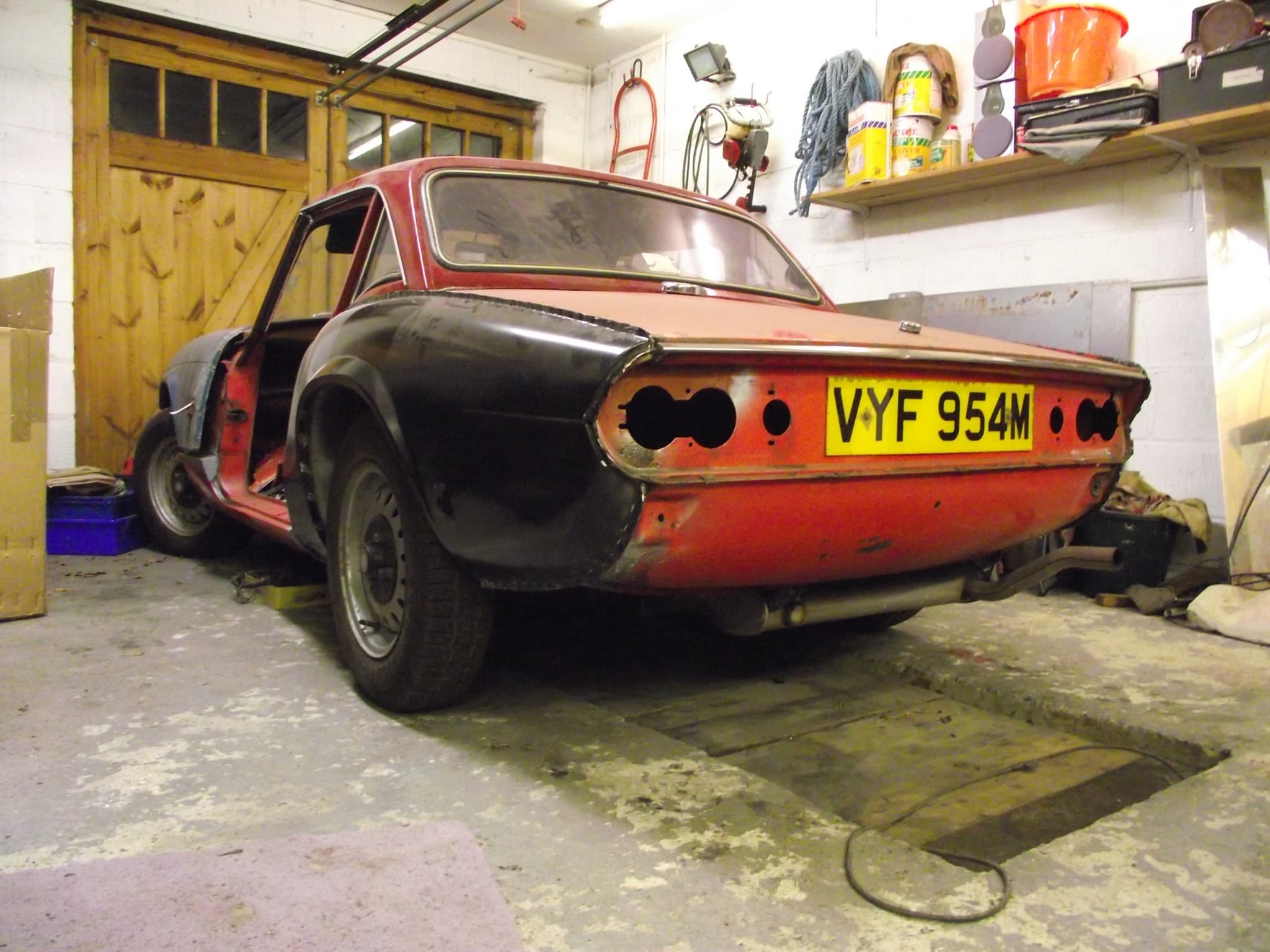
Much of a Spitfire was first made for another car. Motor Sport reported in 1963 that it was built "from Triumph Herald components", and its engines belong to one family with the Herald's, the Toledo's and the Dolomite's; the 1500's engine went into the MG Midget 1500 as well. Spares are plentiful, and the Triumph Sports Six Club (TSSC) and the Vintage Triumph Register both describe the supply as excellent. Other sources name the exceptions, below.source 1source 2source 3source 4source 5
What is still made
Practical Classics summed up the body panels in 2000:
The good news is that every panel is available new, and, barring a few dodgy sills made in the Eighties that may still be floating around, quality is uniformly high.
The TSSC's guide, which is undated, is more guarded: panel supply is reasonably good, it says, with many repair sections now made. The sills (rocker panels) carry much of the car's strength, and replacements come both from Heritage and as reproductions. David Aspinall of Anglian Triumph Services told Hagerty in 2021 that "some repro panels are worse than others".
The sources, read in October 2026, describe these as made again; Hagerty's account of the hoods dates from 2021:source 3source 4source 6source 7source 8source 9source 10source 11
| Part | What is made | Who says |
|---|---|---|
| Front valance, Spitfire 4 to Mk IV | Original-pattern steel again, besides copies in glass fibre and steel | The Dutch Triumph Spitfire Club |
| Rear quarter valances, Mk IV and 1500 | Glass fibre, which is not original, or steel, original or copied; quality varies | The Dutch Triumph Spitfire Club |
| Chrome bumpers | Plated with nickel and then chrome "to the same specification as used by Triumph" | Canley Classics |
| Hoods (soft tops) | Vinyl, the original material, or mohair | Hagerty, 2021 |
| Swing-spring rear | Conversion kits for the Spitfire 4, Mk II and Mk III | Canley Classics, and John Kipping Triumph Spares before it |
| Five-speed gearbox (transmission) | Conversions to a Ford Type 9 box: Moss Motors' kit for 1962–80 cars, and Frontline's, with a 0.82:1 fifth and the gear lever in its original place, for what Rimmer Bros calls the Spitfire 1300 and for the 1500 | Moss Motors; Rimmer Bros |
| Valve-stem oil seals | Seals for the inlet valves, not for heads with double valve springs | Canley Classics |
| Paint | Aerosols and touch-up tins for most Spitfire colours | Rimmer Bros |
What is hard to find
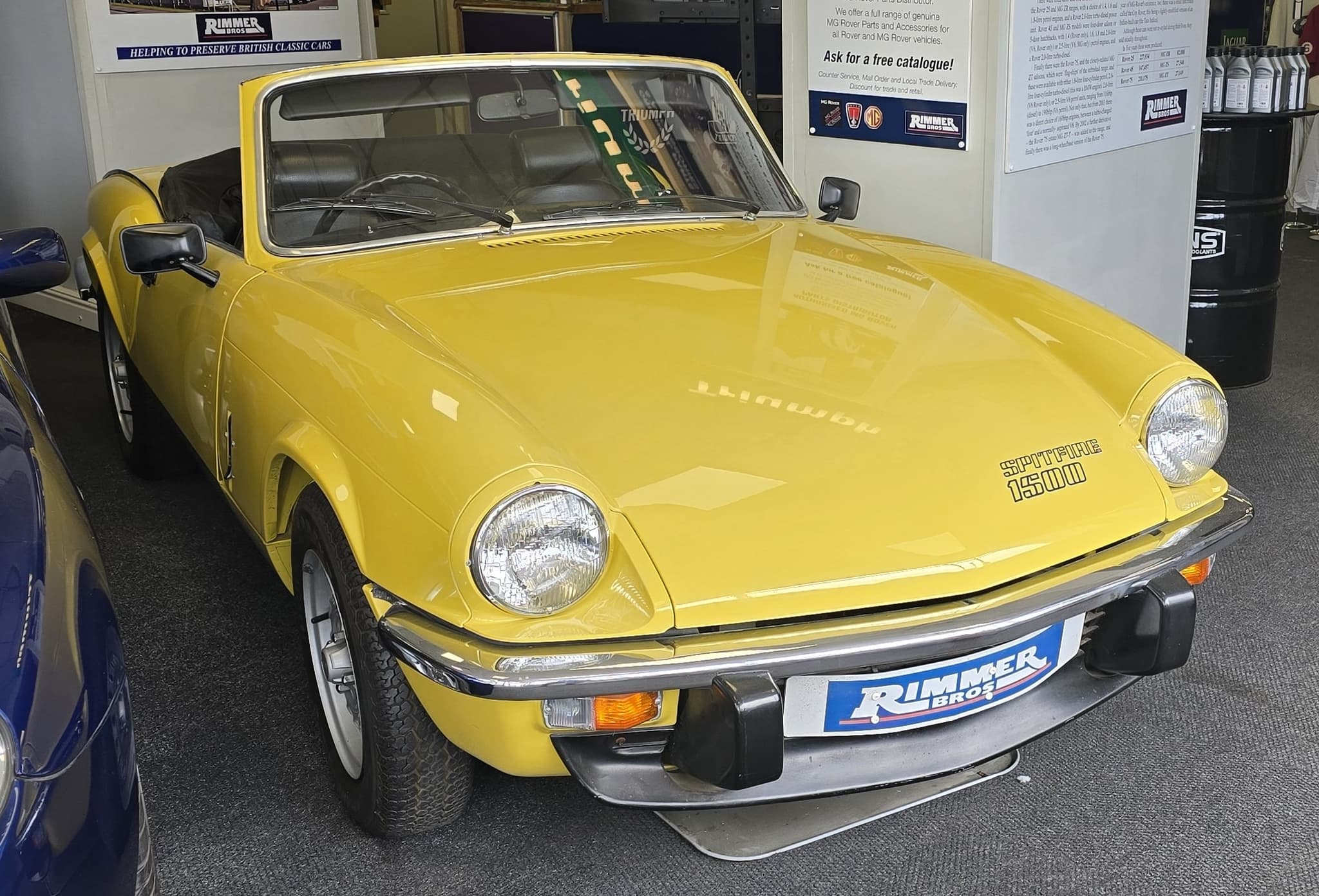
The guides agree that most parts are there; where one names exceptions, it is said below.
Early interior trim
Rubber floor coverings and padded dashboard tops for the earliest cars were hard to find in 2000, Practical Classics reported.
Windscreen frames
On the Spitfire 4, Mk II and Mk III the windscreen (windshield) frame is a separate part, and the Dutch club calls replacements rare ("zeldzaam", in Dutch).
Boot lids
Good boot (trunk) lids are scarce, the Dutch club says, and the rear seam where they rust is hard to repair.
Early paints
Rimmer Bros' paint chart, read in October 2026, listed several early colours as no longer available in aerosols or tins, among them Spa White, Lichfield Green, Phantom Grey and Jonquil Yellow.
What swaps across
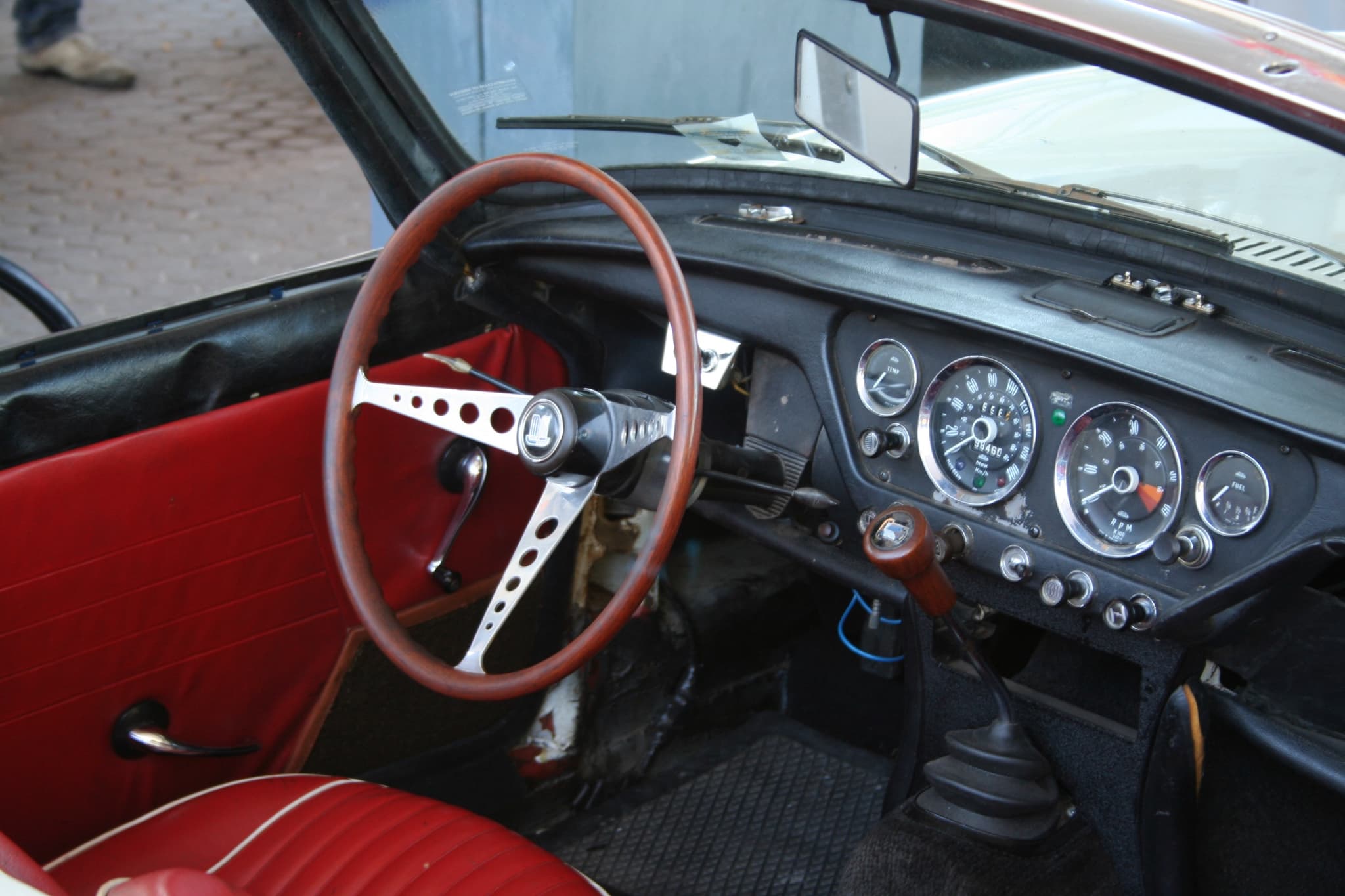
The Spitfire shares its engine family with the small Triumph saloons (sedans), and its chassis design and much of its running gear with them and with the six-cylinder Vitesse and GT6.
| Part | Shared with | What the sources say |
|---|---|---|
| Chassis and running gear | Herald | A modified Herald backbone chassis, trunnion front suspension, rack-and-pinion steering, the swing-axle rear and Girling front disc brakes, in Motor Sport's accounts of 1963 and 1971 |
| Engines | Herald, Toledo, Dolomite 1300 | Canley's chart sets the Spitfire's FC engines beside the Herald 1200's and 12/50's (GA, GD), its FD engines beside the Herald 13/60's (GE) and its FH engines beside the Toledo's and Dolomite 1300's (DG, DH); triumphspitfire.com calls each pair similar |
| The 1500's engine and gearbox | MG Midget 1500; TR7 | The engine is the Midget 1500's, with an FP prefix there; the single-rail gearbox is the Midget's too, and a relative of the TR7's |
| Gearbox swaps | GT6, TR7, Marina, Ital | GT6 gearboxes fit with the right bellhousing and input shaft, and so, in competition cars, does the TR7's; GT6 close-ratio gear sets, and a Marina or Ital set, suit the four-cylinder car |
| Differentials | Herald, Vitesse, GT6, Dolomite | One family of four casing types, A to D; Canley warns that the Vitesse 6's Type C is prone to quarter-shaft failure |
| Front uprights and brakes | GT6 | GT6 front uprights, calipers and discs, with GT6 rear drums, are a common upgrade |
| Rear suspension | GT6 Mk II | It fits, but Triumph Sportscars, an Australian specialist since closed, saw little to gain from it over a properly set-up Mk IV or 1500 rear |
| Overdrive | Other Triumphs with the J-type | Another Triumph's J-type fits once it has the rear housing of the 1500's and the Dolomite's single-rail gearbox, the right flange and speedometer drive, and its pressure correctly set, Canley says |
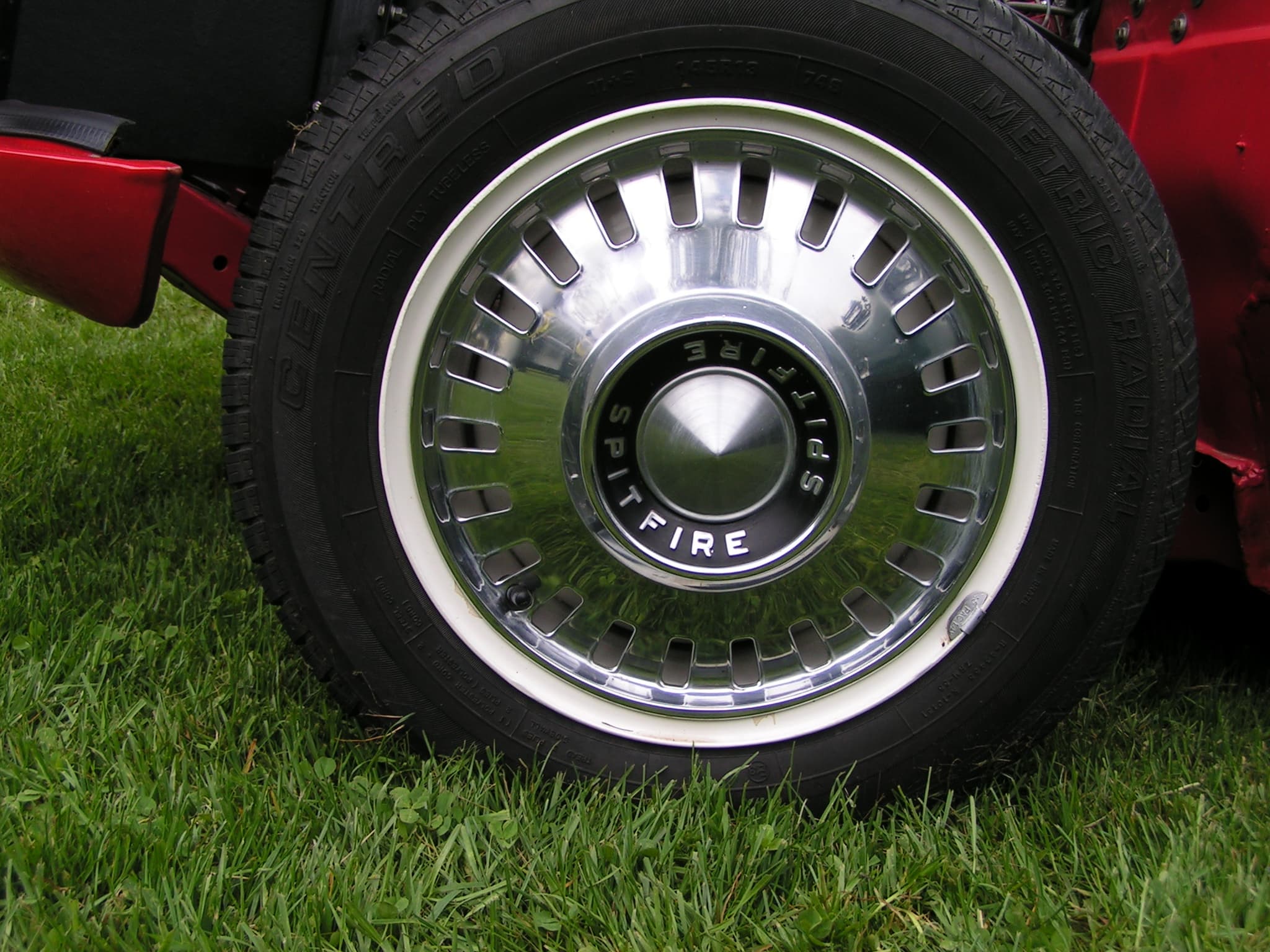
| Steel wheels | GT6+, Triumph 2000, later Vitesse, Herald Courier van | One of the Spitfire's steel wheels is shared with all of them, the Vintage Triumph Register says; specifications gives its size |
| Propshaft | None: the lengths differ | Canley gives working lengths of 1.05 m (41¼ in) for the Spitfire 4 to Mk IV, or 0.97 m (38 in) with overdrive, and 0.97 m (38 in) for the 1500, or 0.94 m (37 in) with overdrive |
Wheel fitment
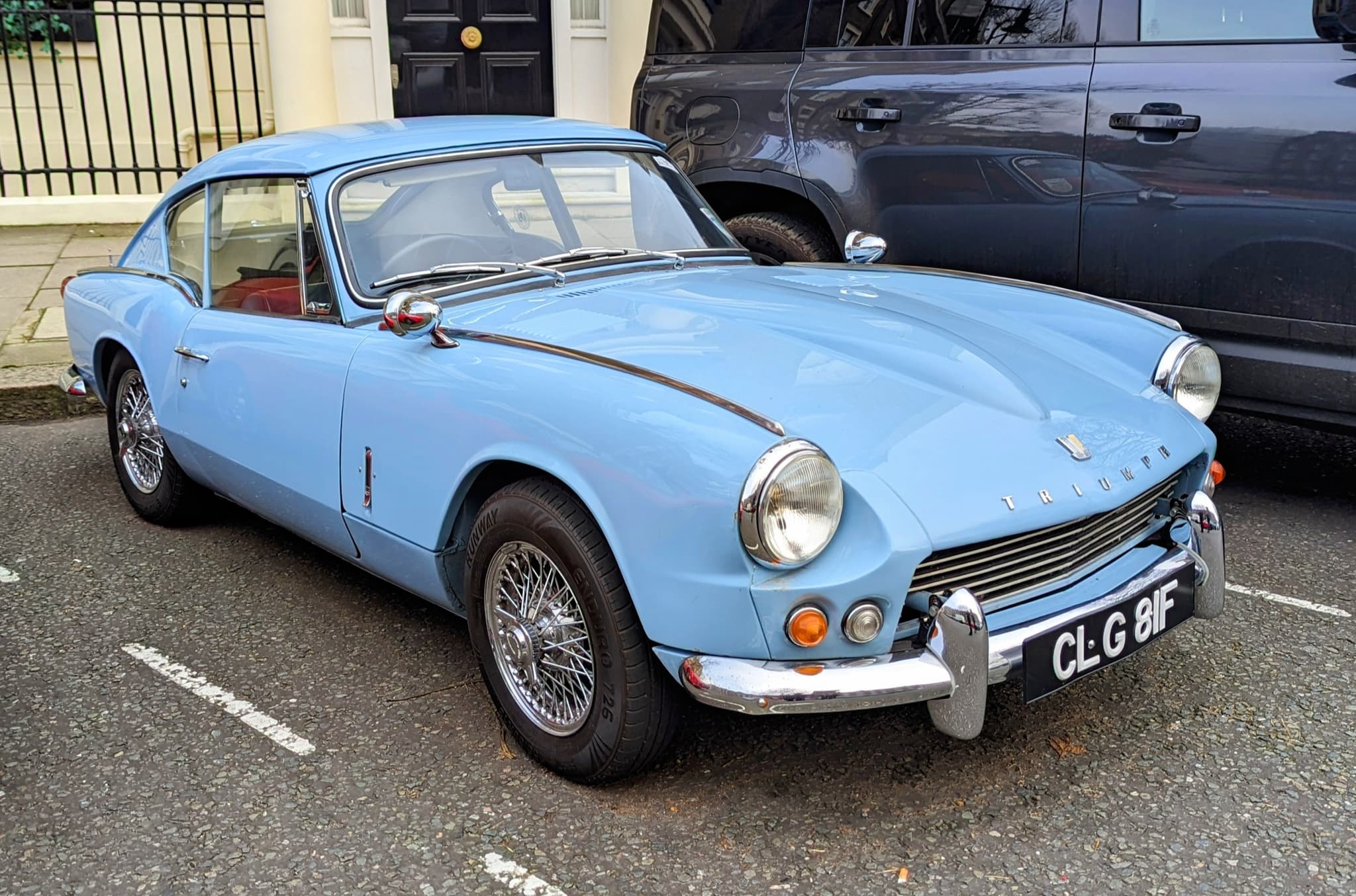
No factory source read gives the Spitfire's wheel fitment, but two suppliers of wheels and hubs agree on its pitch circle.source 16source 17source 18source 19source 13
| Item | Fitment | Who says |
|---|---|---|
| Studs | Four | Rimmer Bros, for a bolt-on wire wheel; triumphspitfire.com agrees |
| Pitch circle | 95.25 mm (3.75 in) | Rimmer Bros, for a bolt-on wire wheel listed for the Mk II and Mk III, rounding to 95.3 mm; Merlin Motorsport, for hubs for the Herald, Spitfire, Vitesse and GT6, giving 3¾ in |
| Stud thread | 3/8 in UNF (3/8-24) | Pegasus Auto Racing Supplies, for a stud sold for the Spitfire and GT6; triumphspitfire.com agrees |
| Which cars | Every Spitfire, 1962–80, by inference | Moss Motors lists one bolt-on wheel for every year, and Merlin's hubs are sold for the whole Herald family |
Clubs
The clubs keep much of the knowledge: the TSSC has register secretaries for the Spitfire, and two clubs run shops.
| Club | Country | What it offers |
|---|---|---|
| Triumph Sports Six Club | Britain | Register secretaries for the Spitfire 4 to Mk III and for the Mk IV and 1500, the monthly Courier, more than 60 local areas and a club shop with more than 400 product lines, by its undated guide |
| Club Triumph | Britain | A magazine every two months and 1,750 members in 2000, as Practical Classics reported them |
| Vintage Triumph Register | United States | A national Triumph club with a Spitfire guide and regional chapters, such as the Texas Triumph Register |
| Triumph Spitfire Club | Netherlands | Founded in 1982, and by its own account the only Spitfire club in the Netherlands; the magazine The Spitfire every two months, a technical committee and a club shop |
| Triumph Sports Owners Association | Australia (Victoria) | The magazine TRaction, which published a history of Giovanni Michelotti in 2023 |
The TSSC's undated guide gave its membership as more than 6,000; Practical Classics gave 18,000 in 2000.
Sources
Sources are given as plain text; their addresses are on the sources page.
- Primarymade at the time, by the maker or by people who were there
- Referenceserious later work: clubs, specialists, magazines, books
- Uncheckedencyclopaedias and enthusiast sites: cited beside a good source, named in the sentence, or marked Unchecked
- Bill Boddy ("W.B."), "Sports cars under £700: the £641 Triumph Spitfire 4", with data panel "The Triumph Spitfire 4", Motor Sport, Apr 1963, p. 20. Primary
- Canley Classics, "Engine Number Identification Chart". Reference
- Practical Classics, "Buyers Guide: Triumph Spitfire", May 2000, p. 81, engine; p. 81; pp. 81–84; pp. 81–82; p. 84, "Which are the owners clubs?". Reference
- Triumph Sports Six Club, Spitfire Buyers Guide (two-page PDF, undated), "Chassis & Bodywork"; p. 2, "Why the TSSC is the club for you". Reference
- Vintage Triumph Register, "Spitfire" (production history, production dates and numbers, buyer's guide tabs), buyer's guide tabs; buyer's guide tabs, wheels. Reference
- Sam Skelton, "Buying Guide: Triumph Spitfire (1962–1980)", Hagerty UK, 3 Feb 2021, sills; hoods. Reference
- Triumph Spitfire Club (Netherlands), "Spitfire modellen", "Aankoop informatie", "Clubinfo", home, "Aankoop informatie"; "Clubinfo"; "Spitfire modellen". Reference
- John Kipping (overdrive articles), Technical articles (group): "Swing Springs", "Rear End Noises", "Propshaft Problems", "Oil Consumption", "Unleaded Engines", "The D-Type Overdrive", "The J-Type Overdrive", "Different Differentials", "Close Ratio Gearboxes For Spitfire MkIV/1500", "Chrome Bumpers", "Spitfire Tuning Kits", "Fitting Le Mans Style Bonnet Vents", Canley Classics, "Chrome Bumpers"; "Swing Springs"; "Oil Consumption"; "Close Ratio Gearboxes For Spitfire MkIV/1500"; "Different Differentials"; "The J-Type Overdrive"; "Propshaft Problems". Reference
- Moss Motors, "Conversion Kit, 5 Speed Gearbox" (440-187). Reference
- Rimmer Bros, Product pages TT30431, TT30430 (5-speed kits), RL1100 (Lenham hardtop), TT30430, TT30431. Reference
- Rimmer Bros, "Triumph Paint Chart", Spitfire table; Spitfire table, read 12 October 2026. Reference
- Bill Boddy ("W.B."), "Road test: The Triumph Spitfire Mk. IV", Motor Sport, Jan 1971, p. 59. Primary
- triumphspitfire.com ("Spitfire & GT6 Magazine and Information Warehouse"), Reference pages (group): models and options; Mk I–1500 options-and-changes logs; engine numbers; 1979–80 VINs; what year is my car; final drive; general specification data; stock tyres; wheel alignment; lubrication; tuning; fuses; paint and trim codes; side stripes; decal and badge placements; wire wheels; head swaps; substitute parts; suppliers; new owner; pre-purchase checklist; spotters guide, pages modified 2023, "Substitute & Interchangeable Parts"; general specification data; wire wheels. Unchecked
- Triumph Sportscars (Australia; closed end of 2016), "Spitty Tips" 2, 3, 4, 5, 6, 8, 19, Spitty Tips 3, 4 and 6. Reference
- Danny Hopkins, "Spit Roast", Practical Classics, Feb 2003, pp. 66–73, brakes. Reference
- Rimmer Bros, "Wire Wheel Bolt-on Tube Type 4.5J x 13" Silver Painted 48 Spoke – 151539WP – MWS". Reference
- Merlin Motorsport, "Aluminium front hubs for Triumph Herald / Spitfire and Vitesse / GT6". Reference
- Pegasus Auto Racing Supplies, "Wheel Stud – 3/8-24, Triumph Spitfire, GT6, some FF" (3546-014). Reference
- Moss Motors, "Minilite Style Wheel – Bolt-On – Silver – 13" x 5.5"" (854-721), fitment list. Reference
- Triumph Sports Six Club, Model pages: Spitfire 4/Mark II (model_ID=24), Mark III (23), Mark IV (25), 1500 (26), register secretaries. Reference
- Fran Madigan (ed.), "Giovanni Michelotti", TRaction (Triumph Sports Owners Association Victoria), Apr–May 2023, masthead. Reference