Harry Webster and the Triumph Spitfire
Standard-Triumph's engineering chief from 1957 to 1968, whose idea the Spitfire was: he wanted a Herald sports car, saw it into production, and took it to Le Mans.
About the pictureA privately owned Spitfire under restoration, not Webster.
Before the Le Mans 24 Hours of June 1965, Harry Webster was photographed beside ADU 4B, the works Spitfire that went on to win its class in the race. The Spitfire had been his idea five years before, and taking it to Le Mans was his decision.
He ran Standard-Triumph's engineering as director of engineering from 1957 until 1968; Graham Robson dates his time in charge from 1956.source 1source 2source 3source 4
An engineer from Coventry
Sources for Harry Webster
Giles Chapman, "Harry Webster" (obituary), The Independent, 17 Feb 2007source 4; The Daily Telegraph, "Harry Webster" (obituary), 9 Feb 2007source 5; Graham Robson, "Harry Webster – My Technical Mentor", Moss Motoring (Moss Motors), 12 Jun 2019source 3; racingsportscars.com, Le Mans 24 Hours 1965, resultssource 2; TR Register, "Triumph TR2 Buyers Guide" (the TR2 data sheet)source 6
Henry George Webster was born in Coventry in 1917 and joined the Standard Motor Company in 1932 as an apprentice, aged 15. During the Second World War he worked in Standard's aero-engine department. He became chief chassis engineer in 1949, under Ted Grinham, and was responsible for the chassis of the TR2; he was chief engineer from 1955, and director of engineering when Grinham retired in May 1957.
"Our rivals were always enormously bigger than we were," he said, as Giles Chapman's obituary in The Independent quotes him.
- 1957
Director of engineering
Standard-Triumph's engineering chief, and his first year of work with Michelotti.
- 1960
Bomb
Michelotti builds Webster's "Herald sports car" as a single prototype.
- 1962
On sale
The Spitfire 4 reaches the showrooms late in the year.
- 1964
Le Mans
Three works fastbacks start; one finishes.
- 1965
The class win
ADU 4B wins the 1.15-litre GT class at Le Mans.
- 1968
Michelotti and Bomb
In 1957 Webster brought Giovanni Michelotti into Standard-Triumph's work. The Daily Telegraph's obituary says he "discovered" the Turin stylist; Graham Robson says Michelotti came through the entrepreneur Raymond Flower and was taken on at Webster's recommendation. The two became close friends, and Webster would drive to Turin and back in a weekend to see him. Michelotti styled the Herald, whose chassis, shortened, would carry the Spitfire.
The Spitfire was Webster's wish for a "Herald sports car" to take on the Austin-Healey Sprite, and Michelotti built it as a single prototype, code-named Bomb, in 1960. Then Standard-Triumph's money ran out, and the car was stored under a dust sheet. Robson credits Webster's "persuasive powers" with winning Leyland's approval for it, the first of the new owner's many new projects; others tell the story of its rescue differently, as the Spitfire's history shows. His deputy put the next stage in one sentence:
We took 'Bomb' from prototype to production car in 15 months.
A month after the launch, Lloyd added, he and Webster took two Spitfires to the Turin show and were stuck in snow on the Mont Cenis pass.source 5source 7source 4source 3source 10
Back to Le Mans, 1964–65
Webster wanted Triumph back at Le Mans, with the programme under his own control. One of his colleagues told Robson how it was done:
Harry squeezed money out of Stanley Markland, decided that we should use Spitfires, and his staff did the rest.
When others doubted that the engine could give 100 reliable horsepower, Robson writes, Webster told his own engineer, Ray Bates, to make it do so, and Bates did it with a prototype eight-port cylinder head. The experimental department built four aluminium and glass-fibre fastbacks, and Webster signed the Finn Simo Lampinen for the rally team. The best results of his racing programme, in the order they came:
- 1964
Le Mans 24 Hours
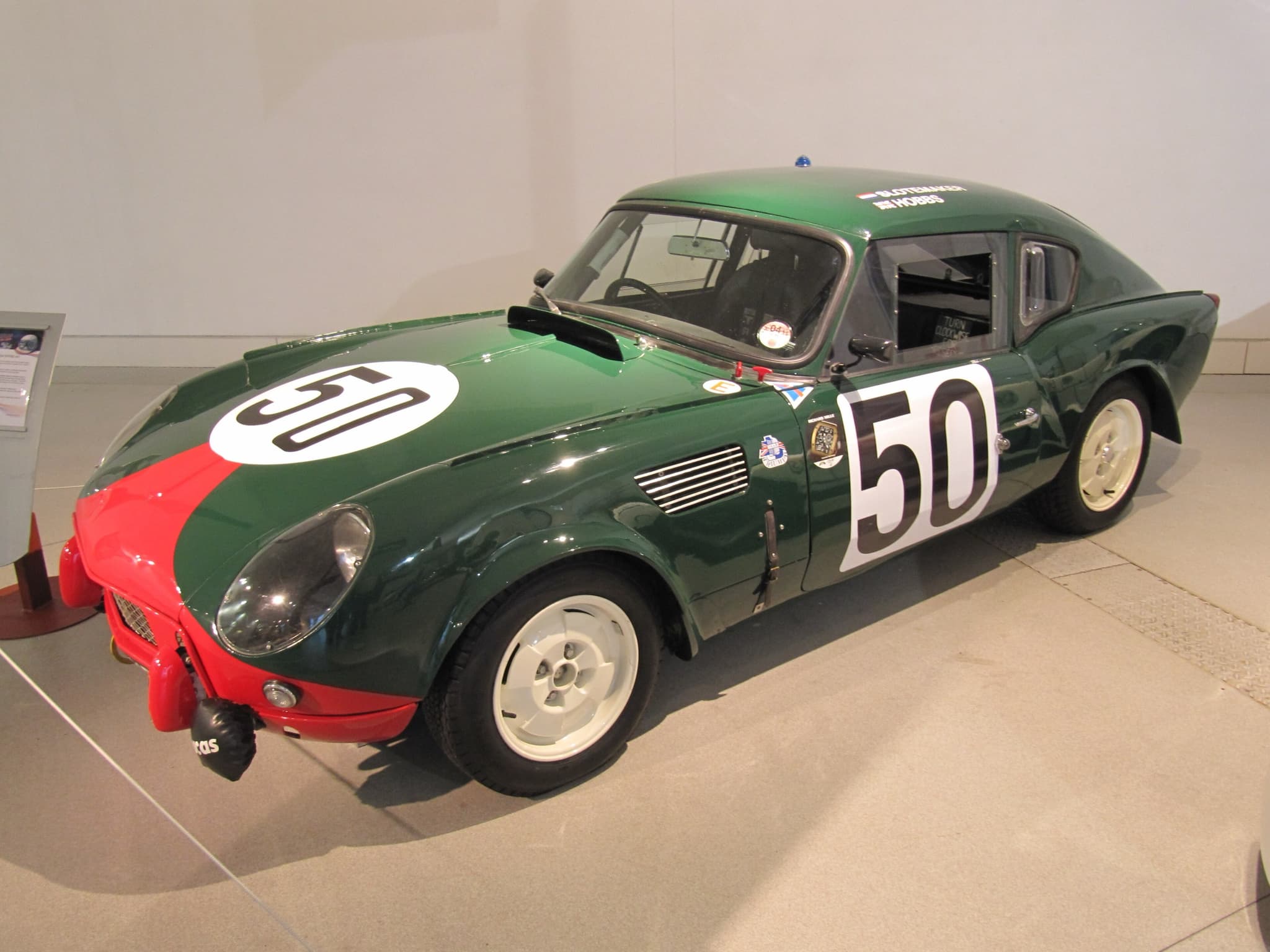
No. 50, ADU 2B, driven by David Hobbs and Rob Slotemaker: 21st overall, and the only Spitfire to finish.
- 1964
Tour de France Automobile
Slotemaker and Terry Hunter win the GT class up to 1,300 cc, 15th overall.
- 1964
Paris 1000 km
Jean-François Piot and Jean-Louis Marnat win the 1.15-litre GT class at Montlhéry, 22nd overall.
- 1964
Geneva Rally
Terry Hunter, 2nd overall in a works Spitfire.
- 1965
Le Mans 24 Hours
ADU 4B, driven by Jean-Jacques Thuner and Lampinen, wins the 1.15-litre GT class, 13th overall; No. 54 is 2nd in class.
- 1965
Coupe des Alpes
Lampinen and Jorma Ahava 1st, and Thuner and J. Gretener 2nd, in the Prototype category.
Longbridge
In 1968 Leyland became British Leyland, and Webster was moved to Longbridge, where from 1969 to 1974 he was technical director of the Austin-Morris division; Spen King took his place at Triumph. He was made CBE in 1974 and was group technical director of Automotive Products until he retired in 1982.
He died at Kenilworth on 6 February 2007, aged 89. Canley Classics still keeps ADU 4B, the car he was photographed with at Le Mans: the one works Le Mans Spitfire to survive complete.source 3source 4source 5source 1source 17
Roles
- 1932
- 1949
- 1955
Chief engineer
1955–1957. Standard Motor Company
Giles Chapman, "Harry Webster" (obituary), The Independent, 17 Feb 2007source 4
- 1957
Director of engineering
1957–1968. Standard-Triumph; took over when Ted Grinham retired in May 1957 (Graham Robson dates his time as technical chief from 1956)
Giles Chapman, "Harry Webster" (obituary), The Independent, 17 Feb 2007source 4; Graham Robson, "Harry Webster – My Technical Mentor", Moss Motoring (Moss Motors), 12 Jun 2019source 3
- 1969
Technical director
1969–1974. Austin-Morris division, British Leyland, at Longbridge; he moved there after British Leyland was formed in 1968
Giles Chapman, "Harry Webster" (obituary), The Independent, 17 Feb 2007source 4; Graham Robson, "Harry Webster – My Technical Mentor", Moss Motoring (Moss Motors), 12 Jun 2019source 3; The Daily Telegraph, "Harry Webster" (obituary), 9 Feb 2007source 5
- 1974
Group technical director
1974–1982. Automotive Products
Giles Chapman, "Harry Webster" (obituary), The Independent, 17 Feb 2007source 4
Sources
Sources are given as plain text; their addresses are on the sources page.
- Primarymade at the time, by the maker or by people who were there
- Referenceserious later work: clubs, specialists, magazines, books
- Databaseresults and listings, entry by entry
- Canley Classics, "Spitfire ADU 4B Le Mans", photo captions; "Our Museum". Reference
- racingsportscars.com, Le Mans 24 Hours 1965, results, results, 13th; results, 13th and 14th. Database
- Graham Robson, "Harry Webster – My Technical Mentor", Moss Motoring (Moss Motors), 12 Jun 2019, the TR2; the Herald sports car; the dust sheet; John Lloyd; Le Mans; the Lampinen photograph; British Leyland. Reference
- Giles Chapman, "Harry Webster" (obituary), The Independent, 17 Feb 2007, header. Reference
- The Daily Telegraph, "Harry Webster" (obituary), 9 Feb 2007. Reference
- TR Register, "Triumph TR2 Buyers Guide" (the TR2 data sheet). Reference
- Graham Robson, "One Design, Many Derivatives", Moss Motoring, 26 Oct 2022. Reference
- Malcolm McKay, "Triumph Spitfire buyer's guide: what to pay and what to look for", Classic & Sports Car, 10 May 2019, Michelotti passage. Reference
- racingsportscars.com, Le Mans 24 Hours 1964, results, results, 21st. Database
- Lancaster Insurance, "The Triumph Spitfire: a celebration", 29 Dec 2021. Reference
- Canley Classics, "Spitfire ADU ~B Le Mans". Reference
- Canley Classics, "Spitfire ADU 2B Le Mans". Reference
- racingsportscars.com, Tour de France Automobile 1964, results, No. 131. Database
- racingsportscars.com, Paris 1000 km 1964 (Montlhéry), results, No. 57. Database
- John Davenport, "Geneva Rally", Motor Sport, Dec 1964, p. 45. Primary
- John Davenport, "Coupe des Alpes", Motor Sport, Sep 1965, p. 30. Primary
- Classic Car Weekly, "Le Mans Spitfire comes home after extended holiday", 2004. Reference